
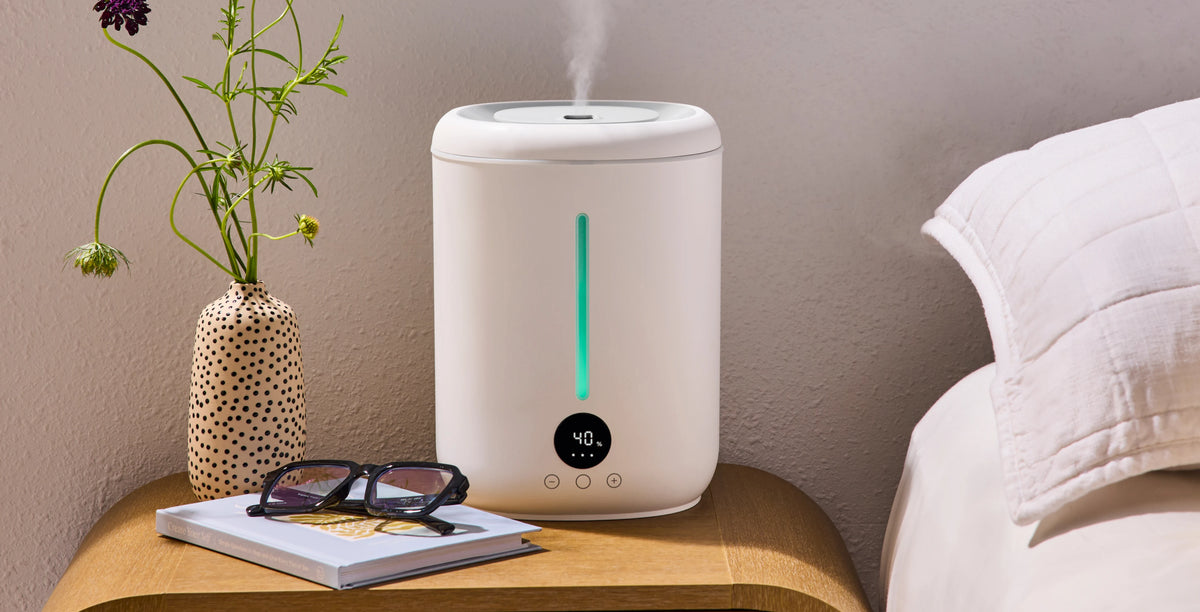


The short answer is yes, ultrasonic humidifiers are safe. But when used incorrectly, they can be unsafe for kids, pets, and individuals with pre-existing health conditions.
There are two main safety concerns with ultrasonic humidifiers: white dust caused from using tap water, and bacterial growth in tanks that are not cleaned regularly.
Both of these issues are very easily solved, so as long as you use the device correctly and properly clean it, ultrasonic humidifiers are safe for your home, especially if you have kids and pets.
Tap Water and White Dust
Ultrasonic humidifiers work by vibrating water at frequencies beyond what a human can hear. The vibrations break water into extremely fine droplets that become airborne. Unlike evaporative humidifiers, which pass air through a wick filter that traps dissolved substances, ultrasonic units have no filtration step. Whatever is in the water goes into the air.
Most ultrasonic humidifiers recommend that you use distilled water to fill the reservoir, including the Molekule Glow ultrasonic humidifier.
Tap water contains dissolved minerals: calcium, magnesium, sodium, and trace amounts of other compounds.
When tap water is used in an ultrasonic humidifier, these minerals are aerosolized along with the moisture and released as fine particles. The visible white powder that settles on furniture near the unit, commonly called white dust, is the large-particle component of this dispersal. The smaller component becomes PM2.5, fine particles small enough to penetrate deep into lung tissue.
The American Lung Association explicitly flags this concern, noting that ultrasonic humidifiers using tap water can disperse minerals and impurities into the air.
Research from Virginia Tech measured PM2.5 concentrations in a test room running an ultrasonic humidifier with tap water and found levels comparable to those measured near cooking activity. A separate study at the University of Alberta found similar results.
This does not mean ultrasonic humidifiers, or more broadly humidifiers, are dangerous. The particles detected were primarily common minerals, not recognized acutely toxic substances.
The specific long-term health implications of breathing elevated concentrations of calcium and magnesium particles for years are not well-studied. What is well-established is that PM2.5 in general is associated with respiratory and cardiovascular effects, and it is reasonable to minimize unnecessary exposure to it.
The solution is simple: use distilled water. Distilled water has had dissolved minerals removed through evaporation and recondensation. When used in an ultrasonic humidifier, it produces no white dust and no measurable mineral PM2.5. It is completely safe to choose an ultrasonic humidifier for your home as long as you plan to fill it with distilled water.
Bacterial Growth in the Tank
The second documented issue is bacterial and mold contamination in the water tank, however, contamination is an issue with any type of humidifier if not cleaned properly.
Consumer Reports tested multiple humidifier types and found that units with contaminated tanks, whether from normal bacterial growth after a few days or from introduced bacteria, frequently emitted microorganisms into the air.
This applies to ultrasonic, evaporative, and warm-mist humidifiers. The ultrasonic type is particularly relevant because, unlike steam vaporizers which boil the water (making them unsafe for households with kids and pets, comparatively to cool mist humidifiers), ultrasonic units disperse whatever is in the tank directly, without any thermal killing step.
Inadequately cleaned ultrasonic and cool-mist humidifiers can disperse bacteria and molds into the air. This is not a theoretical concern. There are documented cases of respiratory illness linked to contaminated humidifier use, most severely the South Korean humidifier disinfectant disaster of 2011, in which commercial cleaning chemicals added to humidifier water became aerosolized and caused a new form of lung disease.
Note: That incident involved the cleaning agents, not the bacteria, but it illustrates how directly humidifier output reaches the lungs.
Regular cleaning addresses this risk. Clean your humidifier every three days if it’s in continuous use and disinfect it completely once per week.
The cleaning agents that work are mild: undiluted white vinegar for mineral deposits and scale, and a diluted bleach solution (one tablespoon per gallon of water) for periodic disinfection. Harsh commercial cleaners should not be added to the water tank.
Are Ultrasonic Humidifiers Safe for Babies and Young Children?
Yes, ultrasonic humidifiers are safe for babies and young children if it’s filled properly with distilled water.
However, if used improperly with tap water, they can be unsafe.
Children breathe at a higher rate relative to body weight compared to adults, and their respiratory systems are more sensitive to particulate exposure.
If you prefer to use an ultrasonic unit in a child's room, use distilled water. This eliminates the white dust issue. Clean the tank every one to two days rather than the standard three-day interval. Position the humidifier at least three feet from the crib so the mist disperses before it reaches the child's immediate breathing zone.
Steam vaporizers present a real burn risk if a child contacts the steam output or pulls the unit over. That is a more immediate and certain hazard than mineral particle exposure from a properly maintained ultrasonic unit using distilled water.
How to Use an Ultrasonic Humidifier Safely
The following steps make an ultrasonic humidifier safe to use:
1. Use distilled water only
Distilled water contains no dissolved minerals, so there are no particles to aerosolize. If your unit has a demineralization cartridge slot, use it. If not, distilled water from a grocery store costs roughly one dollar per gallon and is available everywhere.
2. Clean the tank every two to three days
Drain the tank completely between cleanings. For the cleaning itself: add undiluted white vinegar, let it sit for 30 minutes, scrub with a soft brush, and rinse thoroughly. This removes mineral scale and prevents bacterial buildup.
3. Disinfect weekly
Once a week, use a diluted bleach solution (one tablespoon per gallon of water) in the tank, let it sit briefly, then rinse completely before refilling. Avoid any commercial cleaning products not explicitly approved for humidifier use.
4. Never leave standing water in the tank
If you will not use the unit for 24 or more hours, drain and dry it before storing. This eliminates the primary condition for bacterial growth.
5. Keep room humidity below 50 percent
Over-humidification creates conditions for mold and dust mite proliferation, which worsens the very conditions many people buy humidifiers to address. A standalone hygrometer costs under 15 dollars and removes the guesswork. The EPA and most health authorities recommend maintaining indoor humidity between 30 and 50 percent for optimal air quality.
6. Position the unit appropriately
Place the humidifier at least three feet from beds and seating areas so the mist disperses before being inhaled at close range. This is particularly important in children's rooms.
Can You Pair an Air Purifier with an Ultrasonic Humidifier?
Yes, you can use both an air purifier and ultrasonic humidifier together to maintain ideal humidity and continuously filter allergens and fine particles.
If you opt not to use distilled water for your ultrasonic humidifier, which we strongly encourage you not to, a HEPA air purifier will capture most mineral particles dispersed by an ultrasonic humidifier, reducing the total PM2.5 concentration in the room.
However, using distilled water prevents the problem in the first place, which is more efficient than producing and then capturing them.
It’s important to understand that humidifiers and air purifiers serve complementary functions.
A humidifier benefits your home’s air quality by increasing relative humidity, helping to control dust mite reproduction and dry-air irritation.
An air purifier addresses the particulate, allergens, and VOCs that relative humidity doesn’t impact.
Frequently Asked Questions
Are ultrasonic humidifiers safe to breathe?
Yes, ultrasonic humidifiers are safe when used with distilled water, which prevents the mineral particles that can irritate airways.
Is white dust from ultrasonic humidifiers harmful?
White dust is mineral residue from tap water, and it can be harmful, however it’s easily avoidable if you use distilled water in the reservoir.
Are ultrasonic humidifiers safe for babies?
Yes, ultrasonic humidifiers produce cool mist with no burn risk, making them safer for nurseries than steam vaporizers.
Can an ultrasonic humidifier make you sick?
Only if it isn't cleaned regularly. Bacteria and mold grow in standing water; clean the tank every three days to prevent this.
How often should you clean an ultrasonic humidifier?
Clean the tank every three days during regular use and fully disinfect weekly, otherwise minerals will build up and bacteria can develop quickly in standing water.
Should I use a humidifier and an air purifier together?
Yes, a humidifier maintains healthy moisture levels while an air purifier handles airborne particles, allergens, and VOCs. They complement each other well.


