

September 2026
•
7 min read
You are not losing the war on dust. You’re just not seeing where it starts.
Most of the dust in your house is not on your shelves. It’s in your air, waiting to settle.

By: Mark Ham

KEY TAKEAWAYS

Research published in Environmental Science and Technology estimated that around 60 percent of household dust originates outdoors, tracked in by people or drawn in through windows and ventilation systems.
Particle size matters. A 10-micron particle drops a foot in about two minutes. A 1-micron particle takes hours to fall the same distance.
The dust you can see floating in a sunbeam is the large, heavy particles. The smaller particles that reach your lungs are invisible even in direct light.
Most purifiers capture particles and hold them on a filter. You need molecular destruction to break them down.
THE PART NOBODY EXPLAINS
You can’t dust your air.
That reads like a challenge. It’s actually a scientific fact.
Researchers who monitor airborne particle counts inside occupied homes find the same pattern repeatedly: levels spike during vacuuming, sweeping, and dusting, and stay elevated well after the cleaning stops. Walking across a carpeted room does a smaller version of the same thing. This is known as "resuspension"—settled particles being lifted back into the air by movement.
Source: Indoor Aerosol Research on Particle Resuspension from Household Activity, 2023
That is the missing piece for anyone who has wiped a shelf on Tuesday and found a film on it again by Thursday. "Dusting" is really just relocating the dust. Most of it goes back up into the room, hangs there, and comes down on the same shelf you just cleaned.
Sure, there are products that are good at catching and reducing the dust on surfaces, but what about in your air—the place it's truly coming from? The Swiffer, the good microfiber, the robot vacuum that runs while you’re at work.
Dusting products work on surfaces, but at any given moment, a great deal of your dust is not on a surface at all.
Dust is not what most people think it is.
We’ll start with the myth that almost everyone believes. Household dust is not mostly dead skin. Yes, skin cells are in there, but they’re a minor component.
What dust actually is depends heavily on where you live and what you do, but the broad composition is consistent: textile fibers shed from clothing, bedding, carpets, and upholstery. Pet dander. Dust mite allergens. Soil and outdoor particulate matter. Cooking residue. Fragments of paper, insulation, and building material.
And the biggest single share of it did not start inside your house at all. Research published in Environmental Science and Technology estimated that roughly 60 percent of indoor dust originates outdoors, arriving on shoes and clothing or drawn in through gaps in the building.
Source: Environmental Science and Technology, Migration of Outdoor Soil and Airborne Particulate into Indoor Dust, National Health Institute 2016
That explains something that frustrates even the "cleanest of freaks." You can clean an interior perfectly and the dust keeps arriving, because the dust was never coming from the inside to begin with.

The reason it comes back is physics, not effort.
How fast a particle falls out of the air depends on its size, and it doesn’t scale gently. Large particles fall faster. Smaller ones hang in the air longer, meaning they move from one place to another, such as your airways.
A 10-micron particle, roughly the largest thing in ordinary house dust, drops about a foot in two minutes. A 1-micron particle takes several hours to fall that same foot. Below one micron, particles effectively stop settling at all. They stay up until something moves them, or until they happen to bump into a surface.

A room isn’t just a place where dust hangs out and then falls. It’s more like a reservoir of dust. There’s a population of fine particles suspended in the air, more or less permanently, and the film you wipe up on Thursday is only the heaviest bunch of it—the part gravity caused to fall and collect on the shelf. Meanwhile, the air is still rife with dust you can’t even see.
Every time someone walks across the carpet, sits down hard on the couch, or shakes out a blanket, more of it goes back into the air. Dusting does it too. A dry cloth lifts as much as it collects.
Dust is more than unsightly. It can be dangerous.
Smaller particles do more than make things feel musty and make you sneeze. Some smaller particulate matter can actually enter your respiratory system, cross over into your bloodstream, and in some cases cause respiratory and cognitive effects.
You’ve got a good cleaning stack. Just don’t forget about where dust originates.
It’s worth being fair to your own equipment here, because none of it is failing.
Swiffer and dry dusters: Excellent at collecting the visible layer. A dry pass also lifts fine particles back into the air, which is why a damp cloth outperforms a dry one.
Microfiber cloths: Generally better, because the fiber structure traps rather than pushes. Still a surface tool.
Robot vacuums: Great for daily floor upkeep, but they only clean what has already landed. The finest dust stays in the air above.
Vacuums with sealed HEPA: The right choice, and worth the money. They handle what has already landed in the carpet.
Four sensible purchases. Three of them work on surfaces, which is the half of the problem you can see. The most forgotten tool is usually the most effective, because it stops the dust that’s suspended in your air.

Why a HEPA-only purifier may not be enough to drop the amount of dust in your home.
HEPA stands for High Efficiency Particulate Air. It’s a performance standard for filter media, not a technology, a brand, or a certification body.
In the US, the benchmark comes from the Department of Energy: a filter qualifies if it removes at least 99.97 percent of particles at 0.3 microns. That size was established as a benchmark because, while it’s not the smallest, it’s the hardest one to capture.
For dust, that’s genuinely good performance, and a real HEPA filter pulls fine particulate matter out of the air effectively. But there are two things it hasn’t solved for.

Capture is not the same as purifying: The filter takes particles out of the air and then holds them in place, intact, until you replace it. Everything the dust was carrying is held there with it.
HEPA does nothing against gases: Volatile organic compounds and odors pass straight through the fibers because they aren’t solids.
It can be genuinely difficult to know which purifiers are verified at 99.97 percent at all, given how loosely terms like "HEPA-type" and "HEPA-like" get used across the category.
You need a purifier that’s third-party tested, verified HEPA, and carries technology built for what a filter can’t hold. There’s only one that checks every box.
Every room deserves less dust.

Enter: PECOAir and PECOAir+ (coming soon).
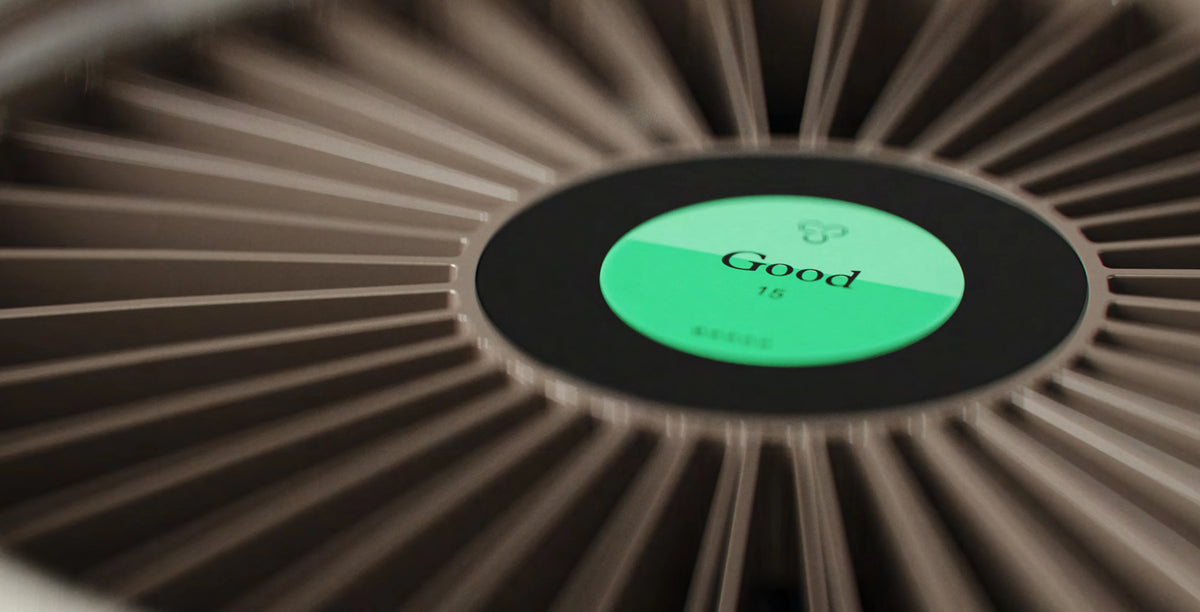
Molekule has been busy designing, testing, and innovating on a new family of purifiers that combine PECO-HEPA Advanced technology with data-driven analytics. The result is a line of devices that go where no air purifiers have gone before.
Whisper-quiet power: A fan system that’s as quiet as it is powerful—a difference that’s felt before it’s heard.
Next-gen PECO: The most advanced generation of PECO technology yet, able to reduce formaldehyde, toluene, benzene, and more.
This is your chance to experience it first.
Get notified for the presale of the new purifiers, built for the half of the problem you were never going to see.
Scientifically better air
™

© 2026 Molekule Group, Inc.