

September 2026
•
6 min read
Mold isn’t just the patch on the wall.
47% of American households have mold growth, whether it’s visible or not. Most of it never shows up as a patch on a wall. Here’s what it takes to clear it out of the air.

By: Mark Ham

KEY TAKEAWAYS

Research published in the journal Indoor Air estimated that almost half of US homes have dampness or mold, making it one of the most common conditions in American housing.
Mold needs very little to start. Growth can begin within 24 to 48 hours on any damp material.
Mold reproduces by releasing spores, which run about 2–10 microns across and travel through the air between rooms.
A visual inspection can show you mold growth, but it won’t reveal the real problem—airborne spores. The human eye can’t resolve anything under about 50 microns.
Most air purifiers capture spores and hold them on a filter. You need molecular destruction to break them down.
THE PART NOBODY EXPLAINS
If you have fought mold in your house, you are in the majority.
Seeing mold on the wall is cause for alarm. Most people feel like it’s a sign that they’re failing to keep their home clean and healthy. The data says otherwise.
A study published in the Indoor Air journal estimated that around 47% of homes in the United States have some form of dampness or mold. The World Health Organization wagers in the same range—about 10–50% depending on the region.
Here’s the thing: those aren’t numbers that describe neglected houses. They describe normal ones.
The reason is that mold doesn’t require much to make itself at home. It needs moisture, a temperature range that most people are comfortable in, and something organic to grow on. Drywall paper, wood framing, insulation backing, carpet padding, and grout are all inviting to mold.
On material that stays wet, the EPA notes that growth can begin within 24 to 48 hours. A slow leak behind a vanity, a humid week with the windows shut, or a bathroom fan that was never vented properly is prime for mold.
Older homes tend to have more of it because they were built with less vapor control and have had longer to accumulate small failures. Humid climates tend to have more of it because the outdoor air itself carries the moisture in. Neither one is a judgment about the person living there. It’s just nature.
Mold is visibly present in almost half of homes. But when it comes to airborne spores, it’s almost everywhere.
The mold you can see is actually a fraction of the mold living around us.
Mold reproduces by releasing spores. These spores generally measure between 2–10 microns across—somewhere between 7 and 35 times narrower than a human hair.
At that size, spores behave less like dust and more like smoke. Small spores fall dramatically slower than large ones, meaning they stay suspended in air for hours, until airflow pushes them into spaces with little ventilation. They move from one room to another with nothing more than a door opening or the furnace turning on.
Outdoors, rain and wind move mold around before it settles. Indoors there’s nothing to clear them. Those tiny particles that hang in the air can be inhaled or moved to smaller crevices of the house, setting up shop for colony growth.
That patch on the wall is the result of spores that were pushed somewhere and took advantage of the humidity and lack of airflow. But there are still spores in the air everywhere.
Why a visual mold check tells you so little about your air.
Unfortunately, there’s no equivalent of a pollen count for indoor mold. What most people have instead is their own eyes. And their eyes are the wrong instrument for the job.
The unaided human eye can see a particle down to somewhere around 50 microns. A mold spore is 2–10. That gap is meaningful, because you won’t see mold until it’s a problem.
By the time growth is visible as a patch, you’re not looking at spores—you’re looking at a colony dense enough to have accumulated into something the eye can register, which takes a great deal of material.

When homeowners see mold, they usually run for the bleach or cleaning supplies and begin scrubbing. But that’s a band-aid on the real problem.

Cleaning the wall just fixes that surface: Scrubbing with bleach or cleaners removes what has taken hold there. It does nothing about what’s currently suspended in the air of the room—a separate population waiting to take hold.
Scrubbing puts more into the air: Brushing, scraping, and wiping lift spores off a surface and into the room. This is why professional mold remediation teams seal an area off before anyone touches the wall.
What about the smell of mold?
If you can’t see it, you can usually smell it—the mildewy sting of mold lurking under a sink or in the laundry room.
Scientifically, that smell isn’t the spores. It’s a group of gases called microbial volatile organic compounds, released as mold grows. If the smell returns after a thorough cleanup, it’s telling you something about the air rather than about the wall.
Mold exposure symptoms range from "annoying" to "emergency."
For those sensitive to molds, prolonged exposure can cause eye irritation, nasal stuffiness, or wheezing, according to the Centers for Disease Control and Prevention. More severe reactions are possible in people with allergies, asthma, respiratory disease, or a weakened immune system, and include fever, shortness of breath, or infection.
How to make a house inhospitable to mold.
Mold is a moisture problem before it’s anything else, so most of the useful work happens well before anyone picks up a brush.
First, take away what it needs.
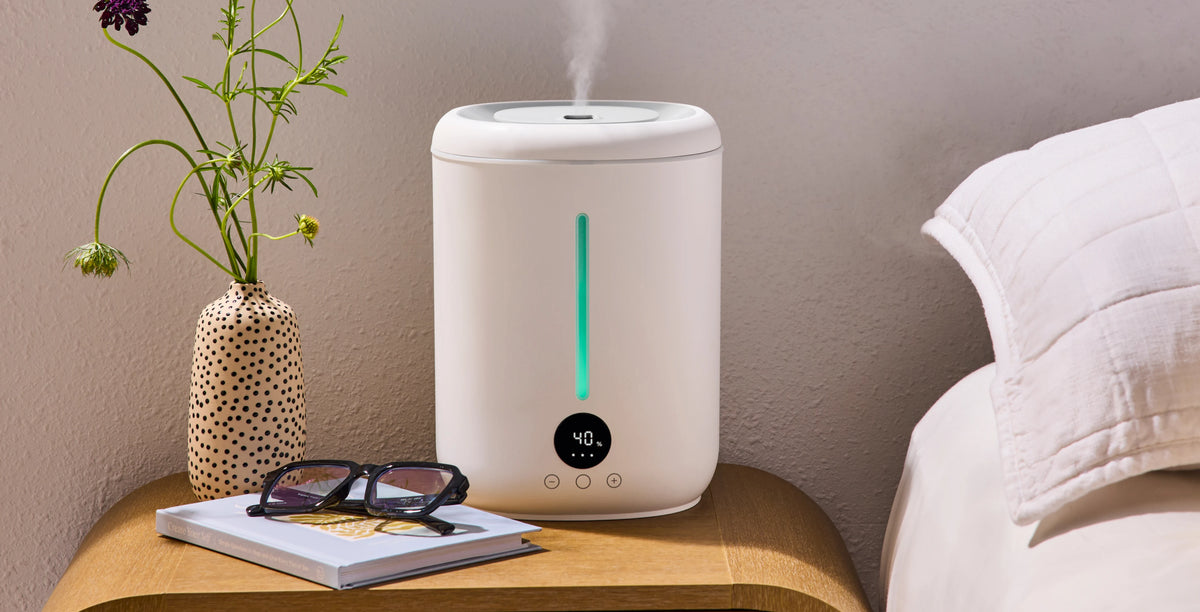
Humidity: Keep relative humidity between 30 and 50% year round, rather than only in summer. A hygrometer or a humidifier with a real-time monitor helps.
Water: Fix leaks quickly. Material that stays wet longer than a day or two is where colonies begin, so speed matters more than thoroughness here.
Ventilation: Run the bathroom fan well past the end of a shower, and confirm the dryer and the fan both vent outside rather than into an attic or crawl space.
Airflow: Keep furniture a few inches off exterior walls so air can move behind it, particularly in rooms that sit below grade.

Then, if you’re cleaning something, do it in a way that doesn’t spread it.
Close the room off first: Shut the door, cover the return vents, and turn the HVAC off while you work so the system isn’t distributing spores through the rest of the house.
Wet the surface before you scrub: A damp surface releases far less into the air than a dry one does.
Know when cleaning is the wrong tool: On porous material like drywall or ceiling tile, growth can extend below where any cleaner reaches—which is why the EPA doesn’t recommend bleach as a general approach, and why badly affected material usually needs replacing.
Filter the air during the work, not after it: Run air filtration in that room while you’re working and for a good while afterward, since that’s when airborne load is highest.
The highest ROI move you can make is to invest in an air purifier that’s proven to destroy mold spores and mycotoxins.
Why a HEPA-only purifier may not be enough… or even what you think.
Conventional, in-home air purifiers rely on HEPA filtration. HEPA stands for High Efficiency Particulate Air—a performance standard for filter media, not a technology, a brand, or a certification body.
In the US, the benchmark comes from the Department of Energy: a filter qualifies if it removes at least 99.97 percent of particles at 0.3 microns. That size is the benchmark because it’s the hardest one to capture.
Mold spores sit well above that threshold, so a genuine HEPA filter captures them effectively. But there are two things it hasn’t solved for.
Capture is not the same as purifying: The filter pulls spores out of the air and then holds them in place, intact, until the filter is replaced.
HEPA does nothing against gases: Volatile organic compounds and odors, including the microbial VOCs behind that musty smell, pass through the fibers because they aren’t solids.
Beyond that, it can be genuinely difficult to know which purifiers are verified at 99.97 percent at all, given how loosely terms like "HEPA-type" and "HEPA-like" are used across the category.
Simply put, you need an air purifier that’s third-party tested, verified HEPA, and has technology that destroys gases.
The only technology proven to destroy mold at a molecular level.
Thus far, only one brand uses Photo Electrochemical Oxidation (PECO). Air passes over a filter coated in a proprietary nanocatalyst. When UV-A light activates the coating, it triggers a reaction on the filter's surface that breaks pollutants apart at the molecular level, leaving only harmless compounds naturally found in the air. Not just captured. Destroyed.
Molekule has spent about 30 years developing PECO, and it's scientifically proven to destroy allergens, mold, viruses, bacteria, and chemicals. No ozone. No harmful byproducts.
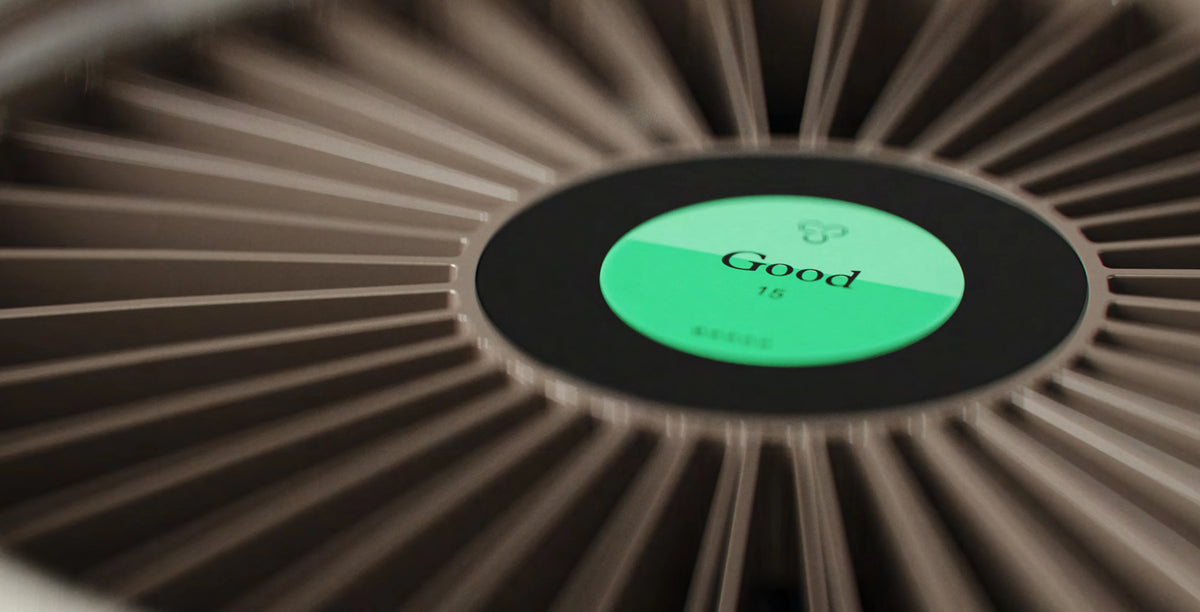
In PECOAir and PECOAir+ purifiers, it’s combined with carbon and HEPA filtration for PECO-HEPA Advanced. Carbon takes gases and household odors. HEPA takes particles at 99.97 percent. PECO handles what the other two can only hold onto.
Carbon: Neutralizes gases and household odors
HEPA: Captures particles at 99.97%
PECO: Destroys what the other two can only hold onto
In a world where mold is more present than ever, every home deserves an air purifier that works.

Enter: PECOAir and PECOAir+ (coming soon).
Molekule has been busy designing, testing, and innovating on a new family of purifiers that combine PECO-HEPA Advanced technology with data-driven analytics. The result is a line of devices that go where no air purifiers have gone before.
Whisper-quiet power: A fan system that’s as quiet as it is powerful—a difference that’s felt before it’s heard.
Next-gen PECO: The most advanced generation of PECO technology yet, able to reduce formaldehyde, toluene, benzene, and more.
This is your chance to experience it first.
Get notified for the presale of the new purifiers, built for the half of the problem you were never going to see.
Scientifically better air
™

© 2026 Molekule Group, Inc.