

September 2026
•
5 min read
Air pollution is worse than ever. That means indoor air is, too.
Indoor air is shown to be 2–5 times more concentrated than outdoor air.

By: Mark Ham

KEY TAKEAWAYS

Outdoor air is federally regulated and those rules are in flux. Indoor air has never been regulated at all.
The EPA reports that levels of some pollutants run two to five times higher indoors compared to outdoors.
Closing a window does not seal a building. A substantial share of outdoor fine particulate matter gets in regardless.
Much of what traffic produces is gas rather than solid, and a HEPA air purifier does nothing against a gas.
THE PART NOBODY EXPLAINS
The cleanest air you breathe all day is probably outside.
That sounds backwards, and most people hear it that way the first time. The assumption is that the front door is a boundary—outside is the city, inside is yours, and closing the door behind you is where one ends and the other starts. The measurements don’t support that.
The EPA puts Americans indoors roughly 90 percent of the time, and has found indoor concentrations of some pollutants running two to five times higher than the levels measured outside.
Source: US Environmental Protection Agency, indoor air quality
Which means the place you spend nine tenths of your life may hold the dirtiest air in your day—and the smoggy city air you worry about may actually be cleaner.
Your indoor air doesn’t have a self-cleaning mechanism like the environment does.
Outdoors, air quality is naturally regulated by elements like rain, wind, and UV light. Moisture weighs down particulate matter, wind pushes airborne pollutants to new areas, and natural sunlight can sterilize things to an extent.
Climate-controlled buildings and homes are different. There are no natural elements to maintain the health of the air. Instead, it’s circulated through HVAC systems and fans, and largely held in place by closed windows and walls.
So while the indoors is protecting us from the harsh elements, it’s also becoming a container for all sorts of chemicals and pollutants—trapping us in a cycle of progressively dirtier air.
Closing a window isn’t enough to keep out the bad stuff. Neither is a simple HVAC or HEPA filter.
It’s a balancing act of ventilation vs. infiltration.
Experts in building health and wellness organizations consistently stress the importance of ventilation and purification. Why? Because a building is not a sealed safe space.
A phenomenon known simply as "infiltration" is the anti-ventilation—it’s when fine particles and gases sneak through a building’s defenses, entering through cracks and crevices. Studies show that older buildings (pre-1980) actually "leak" more. So a closed window may buy protection from large swaths of pollutants, but it isn’t a fail-safe.
Source: Residential Infiltration Factor Research for Fine Particulate, ASHRAE
Regulations on clean air have recently been eased.
Outdoor air in the US is governed by the Clean Air Act, and those standards are being actively rewritten. In March 2025, the EPA announced a review of 31 environmental regulations. Since then it has finalized a repeal of strengthened mercury and air toxics limits for coal plants, proposed delaying tighter vehicle standards for nitrogen oxides and particulate from model year 2027 to 2029, and paused assigning a dollar value to the health benefits of fine particle matter and ozone rules. Much of it is being litigated.
You can hold any view you like about that. Here’s the part that doesn’t depend on your view.
Every one of those rules governs the air outside. There has never been a federal standard for the air inside your home, under this administration or any before it. No agency sets a limit for your living room, and no ruling either way changes what you’re breathing in your bedroom tonight.
You’re monitoring your air, not cleaning it.
There are a lot of misconceptions about what "cleans" your air at home. The truth is, it’s really about monitoring—until now.
Houseplants: The famous study everyone half-remembers ran in a sealed chamber. Researchers who later scaled it to a real room found the effect negligible next to opening a window. Keep them because they’re beautiful, not because they’re giving you clean oxygen.
Air quality monitors: Useful, but measurement is not intervention. A monitor tells you the number went up. It has no opinion about lowering it.
The building HVAC: In an older building, this is moving air rather than cleaning it, and possibly redistributing what it collects.
A HEPA purifier: The closest anyone has come, and the reason for the next section.
A HEPA-only purifier is not enough for healthy air.
HEPA (High Efficiency Particulate Air) is a good standard and it's worth saying so. It’s a benchmark for filter media rather than a technology or a brand, and a filter qualifies by removing at least 99.97 percent of particles at 0.3 microns. Against soot and road dust, that’s real performance.
The problem is the word in the middle of the name: Particulate. All of that engineering catches solids, and much of what a city puts through your apartment is not solid. Nitrogen dioxide is a gas. Volatile organic compounds are not particles. They pass through HEPA media as though it weren’t there. And what a filter does catch, it stores rather than removes—intact, until somebody changes it.
Whether you live in a city or just near one, you need something third-party tested, verified HEPA, and built for the half a filter can’t touch. There’s only one that checks every box.
Beyond that, it can be genuinely difficult to know which purifiers are verified at 99.97 percent at all, given how loosely terms like "HEPA type" and "HEPA like" get used across the category.

The only technology proven to destroy pollutants at a molecular level.
Thus far, only one brand uses Photo Electrochemical Oxidation (PECO). Air passes over a filter coated in a proprietary nanocatalyst. When UV-A light activates the coating, it triggers a reaction on the filter's surface that breaks pollutants apart at the molecular level, leaving only harmless compounds naturally found in the air. Not just captured. Destroyed.
Molekule has spent about 30 years developing PECO, and it's scientifically proven to destroy allergens, mold, viruses, bacteria, and chemicals. No ozone. No harmful byproducts.
In PECOAir and PECOAir+, it’s combined with carbon and HEPA filtration for PECO-HEPA Advanced. Carbon takes gases and household odors. HEPA takes particles at 99.97 percent. PECO handles what the other two can only hold onto.
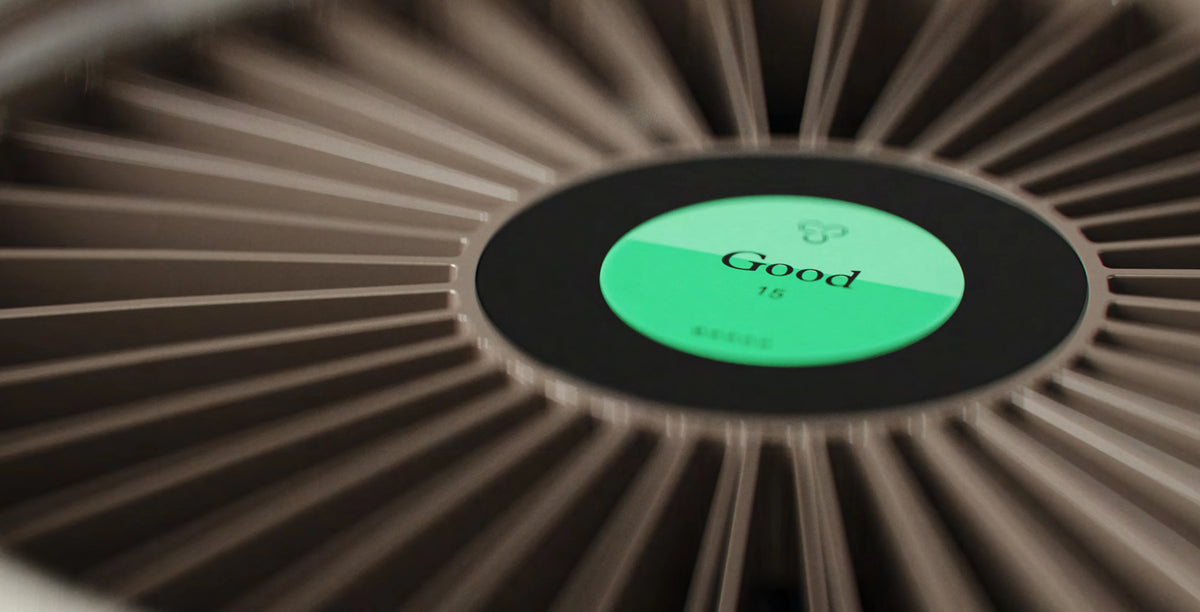
PECOAir+ reads the room and reports what it finds in plain language rather than a vague score.
Carbon: Neutralizes gases and household odors
HEPA: Captures particles at 99.97%
PECO: Destroys what the other two can only hold onto
This is your chance to experience it first.
Get notified for the presale of the new purifiers, built for the half of the problem you were never going to see.
Scientifically better air
™

© 2026 Molekule Group, Inc.