


You've read every productivity book. You've tried the timers, the blockers, the playlists. You invested in the chair. You drink the water. You've even started taking the walks.
Here's the lever most people never pull: the air in the room.
It sounds silly, but it isn't. Some of the most rigorous recent research on cognitive performance keeps landing on the same unglamorous variable, and the results are specific enough to take seriously.
Elite players, measurable dips
In a study published in Management Science, MIT researchers analyzed roughly 30,000 chess moves made by 121 players across three multi-week tournaments in Germany. Inside each venue, sensors tracked PM2.5 (fine particulate matter), CO2, temperature, humidity, and noise, then matched those conditions against the quality of every move.
Here's what they found. When PM2.5 rose, players made more mistakes, and the mistakes themselves got bigger. A 10 µg/m³ increase in fine particulate matter raised the probability of an error by roughly 2.1 percentage points, and the magnitude of those errors grew by about 10.8%. Under time pressure, both numbers climbed higher. The researchers replicated the pattern against 20 years of historical data from Germany's top chess league, and it held up.
These are elite players with years of training, tournament-level focus, and the kind of working memory most of us would envy. They still couldn't compensate for the air around them.
The remote work study
If you're tempted to file that under "interesting but not me," a 2024 Harvard study is harder to brush off. Researchers at the Healthy Buildings program followed 206 remote and hybrid workers for a full year, prompting them to take short cognitive tests at home while sensors tracked CO2, PM2.5, temperature, and humidity in the room.
CO2 was the standout. Cognitive scores dropped 4.5% once CO2 crossed 640 ppm, which is below the level most guidelines flag as a problem, and well within the range a closed-door home office will hit during a normal workday. At 900 ppm, scores were 15% lower. At 1,400 ppm, they were roughly cut in half.
Different studies, same pattern: as indoor air quality degrades, decision-making degrades with it. The drop is subtle enough that you probably wouldn't notice it in the moment, but it's measurable, and it shows up in the exact faculties knowledge work depends on.
The reframe
The usual way to talk about this is to make it scary. Dirty air is slowing you down, costing you focus, making you error-prone. All true, technically. But the more useful framing runs the other direction.
Clean air is a performance input, the same way sleep and hydration and sunlight are performance inputs. It's a lever you can pull that reliably moves the needle on how you think, and almost no one is pulling it yet.
That last part is what should actually grab your attention. Most productivity advantages are already priced in. Everyone has the good chair. Everyone has the app. Clean air is one of the last unclaimed upgrades, and it shows up everywhere the stakes are real. It's in the room with the door closed, on the call that matters, across the table from the kid stuck on a math problem. Those are the moments where a 4.5% dip in cognitive performance actually costs you something, and if you've already optimized everything else about your setup, this is the variable you haven't touched yet.
What this looks like in practice
You don't need an HVAC overhaul. For most home offices and family rooms, a single well-placed air purifier handles it, running quietly in the background while you do the work.
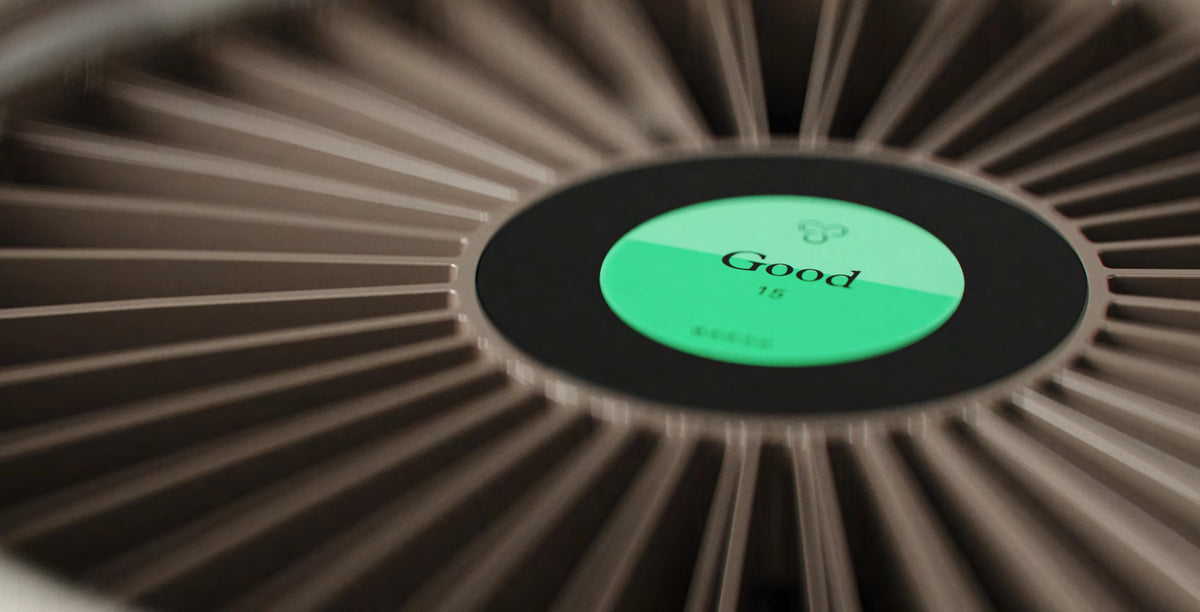
Molekule's Air Mini+ is built for exactly this: a workspace, a bedroom, a kid's homework setup. It pulls out PM2.5, VOCs, allergens, and other things you'd rather not be breathing, without whining fans or blinking lights competing for your attention. For larger spaces like open-plan living rooms or big home offices, the Air Pro covers rooms up to 1,000 square feet.
The difference between HEPA alone and what Molekule does is worth knowing. HEPA filters capture particles but don't address VOCs, so those gases keep circulating. PECO (Photo Electrochemical Oxidation) technology breaks pollutants down at the molecular level. Put the two together and you get the full picture: particles captured, VOCs destroyed. The cognitive benefit isn't something you'll feel in the moment. It's something you'll notice at the end of the day, when the work turned out a little better than usual and you're not sure why.
The bottom line
Everyone's looking for the next edge. The next tool, the next system, the next subscription. The one sitting right in front of you, in the air of the room you're reading this in, is one of the few real ones left.
Clean air isn't a wellness accessory. It's how sharp minds stay sharp.
Discover the science-backed purifier that gives your best thinking room to work.


