


If you’re shopping for a humidifier for your home and recently realized there are both ultrasonic humidifiers and evaporative humidifiers, you’re not alone. Most fundamentally understand what a humidifier does, much less the difference between the two.
They both increase your home’s relative humidity, but the way they do it differs in terms of noise level, water quality requirements, maintenance effort, safety, and indoor air quality.
The right humidifier for your home depends on how you plan to use it, where it will be running, and whether you are willing to manage specific maintenance requirements for each.
How Each Type Works
Ultrasonic Humidifiers
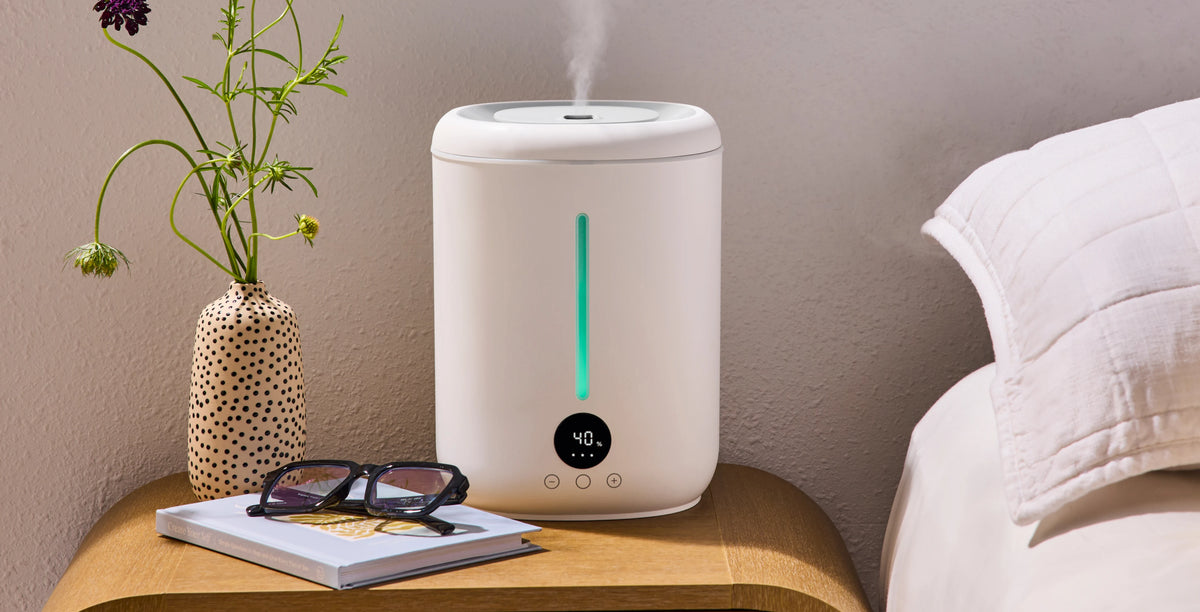
An ultrasonic humidifier uses a small metal diaphragm that vibrates at frequencies above the range of human hearing. The vibrations break water into an extremely fine mist of droplets, which is then released into the room air. The process requires no heat and very little energy, which is why ultrasonic units tend to be quiet and inexpensive to operate.
The “trade-off” is that whatever is dissolved in the water gets aerosolized along with the moisture. Tap water contains minerals including calcium, magnesium, and trace amounts of other compounds. An ultrasonic unit disperses these into the air as fine white particles, which settle on furniture and surfaces as "white dust." The particles are also small enough to be inhaled.
But if you simply fill the reservoir with distilled water, as most product instructions recommend, you eliminate this possibility altogether. Ultrasonic humidifiers are significantly safer when using distilled water.
Evaporative Humidifiers
An evaporative humidifier works differently. Water is absorbed into a wick filter, and a fan draws air through the saturated wick. As air passes through, moisture evaporates into it and is released into the room. The wick filter acts as a physical barrier that traps minerals and other dissolved substances, which stay in the filter rather than entering the air.
This process is self-regulating: as room humidity rises toward saturation, evaporation slows naturally. An evaporative humidifier will not over-humidify a room the way an unmonitored ultrasonic unit can. The cost is noise from the fan and the need to replace wick filters periodically.
Ultrasonic vs Evaporative Humidifiers: Feature Comparison
| Feature | Ultrasonic | Evaporative |
|---|---|---|
| Noise level | Very quiet (25-35 dB), great for bedrooms and nurseries | Audible fan noise |
| White dust / mineral dispersal | Yes, with tap water | None |
| Water requirement | Distilled or demineralized for clean output | Tap water is fine |
| Filter maintenance | No filter; clean tank regularly | Wick filter replaced every 1-3 months |
| Self-regulating humidity | No | Yes |
| Energy use | Low | Moderate (fan) |
| Unit cost | Varies; often higher at premium end | Often lower |
| Best use | Bedrooms, small quiet spaces | Larger rooms, households with hard water |
| Maintenance | Replace with distilled water when empty, clean once per week | Replace with water when empty (distilled or tap), clean once per week |
Which Is Better for Your Home?
Choose an ultrasonic humidifier if you need quiet operation for a bedroom or nursery, you are willing to use distilled water consistently, or you want a compact unit for a small space.
Choose an evaporative humidifier if your tap water is hard and you do not want to purchase distilled water regularly, you want humidity that regulates itself without a smart app or hygrometer, or you want simpler water quality management.
What Humidifiers Do Not Address
Both types add moisture to the air. Neither type addresses airborne allergens, mold spores, bacteria, or VOCs that are already circulating in the room. If indoor air quality is the underlying concern rather than humidity specifically, a humidifier is only part of the solution.
Pairing a humidifier with an air purifier offers more benefits than either appliance does on its own. A humidifier maintains the humidity range that reduces dust mite reproduction and dry-air irritation. An air purifier addresses the particulate and biological contaminants that humidity management does not reach.
Molekule's Glow Humidifier is designed for use alongside Molekule air purifiers as part of a complete indoor air management approach. For rooms where you are already running an air purifier for allergen and VOC control, the Glow adds the humidity component without competing with the purifier's function.
Frequently Asked Questions
Do ultrasonic humidifiers increase PM2.5 levels?
No, ultrasonic units do not increase PM2.5 levels as long as you fill the reservoir with distilled water.
Which type is better for a bedroom?
How often do evaporative humidifier filters need to be replaced?
Every 1–3 months depending on use and water hardness, a clogged wick reduces output and becomes a breeding ground for bacteria.
Can I use tap water in an ultrasonic humidifier?
You should not use tap water in an ultrasonic water humidifier because tap water minerals will be dispersed as white dust and fine particles, causing both cosmetic issues and adverse health effects.
What is the right humidity level for a home?
The ideal humidity level for a home is between 30–50%. Below 30% dries airways, above 50% encourages mold and dust mites.


