

September 2026
•
7 min read
You don’t have to live near a wildfire to spend a week breathing one.
Wildfire smoke travels thousands of miles, carries whatever the fire happened to burn, and gets into sealed homes.

By: Mark Ham

KEY TAKEAWAYS

In June 2023, smoke from fires in Canada gave New York City the worst air quality of any major city on earth. The nearest fires were roughly two thousand miles away.
Wildfire smoke is not only burning wood. When a fire reaches houses, it burns plastics, insulation, treated lumber, vehicles, and electronics, and the smoke carries the chemicals.
Most wildfire smoke particles are well under one micron, small enough to enter a closed house through cracks and crevices and stay there.
Researchers have found that fine and ultrafine particles can reach the brain, and the link between fine particulate matter and heart attack, stroke, and premature death is well established.
The smoke smell is gas. A HEPA-only air purifier can’t do much against gas.
THE PART NOBODY EXPLAINS
Smoke does not stay near the fire.
Wildfires have become an unfortunate reality across the globe, and most people treat the smoke as a regional problem—"if I don't live near it, it's not affecting me." Meteorology disagrees.
Smoke plumes rise into the upper atmosphere and ride weather systems across continents. In June 2023, smoke from wildfires burning in Quebec and Ontario turned the sky over New York orange and gave the city the worst measured air quality of any major city in the world that day. The nearest fires were roughly two thousand miles away.
Which means fire season is no longer a question of proximity. It is a question of wind.
Wildfire smoke is more than just burnt trees.
This is the part that has changed most in the last decade. When a fire stays in the forest, the smoke is largely the product of burning vegetation. But when the fire reaches the edge of a town, it begins consuming houses, cars, buildings, and more. Those things aren’t made of wood alone—vinyl siding, PVC pipe, foam insulation, treated lumber, carpet, paint, wiring, appliances, electronics, and the cars in the driveway. All of it burns.
Sampling after urban fires has shown the presence of heavy metals, benzene, formaldehyde, and a long list of volatile organic compounds in the resulting smoke, along with compounds that lingered inside surviving homes for months afterward.
Source: Post-fire Indoor Contamination Research, Wildland Urban Interface Events, ScienceDirect
So the smoke arriving at your house is not just a campfire odor. It is a deadly brew of everything the fire has burned.
Closing a window is not enough.
Wildfire smoke particles are microscopic. Most fall well below one micron—roughly 1/70 the width of a human hair. Particles that small behave more like a gas than dust or ash.

PM2.5 (particulate matter 2.5 microns and smaller) gets through the same gaps that admit outdoor air on any other day—around window frames, under doors, through vents, and through the building facade itself. Sealing a house slows that considerably but doesn’t stop it. And once smoke is inside, a closed house has no rain and no wind to clear it. The seal that kept some of the smoke outside now holds the rest of it indoors.
None of that is a failure on anyone’s part. Towels under the doors is genuinely good advice. It was simply never going to be sufficient.
Your air quality app is reading a monitor down the road.
During a smoke event, most households do exactly the right things—windows shut, AQI checked hourly, plans rearranged around a number.
But the brutal truth is that the number you're seeing is coming from an outdoor regulatory monitor, sometimes miles away. It measures the air over your neighborhood but says nothing whatsoever about the air in your living room.

What the research says about the exposure.
The evidence on fine particulate matter is substantial, and it's not reassuring. Short-term exposure is associated with heart attack and stroke. Long-term exposure with premature death. The World Health Organization and the EPA both treat PM2.5 as a cardiovascular risk, not merely a respiratory one.
Researchers have also traced these particles beyond the lungs. Fine and ultrafine particulate matter has been shown to enter the bloodstream and reach the brain, either by crossing the blood-brain barrier or by traveling along the olfactory nerve, and a growing body of work connects that exposure to neuroinflammation.
Which reframes what a wildfire really is—not just an inconvenience with a bad smell, but a critical health event.
What most households already do, and what each thing actually accomplishes.
Closing windows and sealing doors: Slows infiltration and is worth doing every time. But it cannot seal a house entirely.
Waiting it out: Reasonable when an event lasts a day. Smoke events now routinely run a week or longer, which turns waiting into a week of continuous indoor exposure.
Running the HVAC on recirculate: Sound advice, and it depends entirely on the filter in the system. Most residential filters aren't rated for particles this small.
A HEPA purifier: The single most useful thing on this list, but not nearly enough for the true dangers of wildfires. See the next section.
If your house still smells like smoke, your HEPA-only air purifier isn't enough.
HEPA is a real standard and it earns its reputation. It's a performance benchmark for filter media rather than a technology or a brand, and a filter qualifies by removing at least 99.97 percent of particles at 0.3 microns—the size hardest to catch. Against wildfire particulate matter, that's exactly the right tool.
But smoke is not only particles. Combustion produces gases, and it's the gas that carries the odor. Particles at that size have no smell.
So when a house smells like smoke with every window shut and a HEPA purifier running in the corner, that's not a broken machine or a bad brand. It's accurate reporting.
The filter is handling the particles, but the volatile compounds are passing through the HEPA media because there's nothing solid for the fibers to catch.
The smell is the half of wildfire smoke that HEPA alone was never built to handle.
The only technology proven to destroy allergens at a molecular level.
Thus far, only one brand uses Photo Electrochemical Oxidation (PECO). Air passes over a filter coated in a proprietary nanocatalyst. When UV-A light activates the coating, it triggers a reaction on the filter's surface that breaks pollutants apart at the molecular level, leaving only harmless compounds naturally found in the air. Not just captured. Destroyed.
Molekule has spent about 30 years developing PECO, and it's scientifically proven to destroy allergens, mold, viruses, bacteria, and chemicals. No ozone. No harmful byproducts.
In PECOAir and PECOAir+ purifiers, it's combined with carbon and HEPA filtration for PECO-HEPA Advanced. Carbon takes gases and household odors. HEPA takes particles at 99.97 percent. PECO handles what the other two can only hold.
Carbon: Neutralizes gases and household odors
HEPA: Captures particles at 99.97%
PECO: Destroys what the other two can only hold onto

And for the first time during a smoke event, actual guidance.
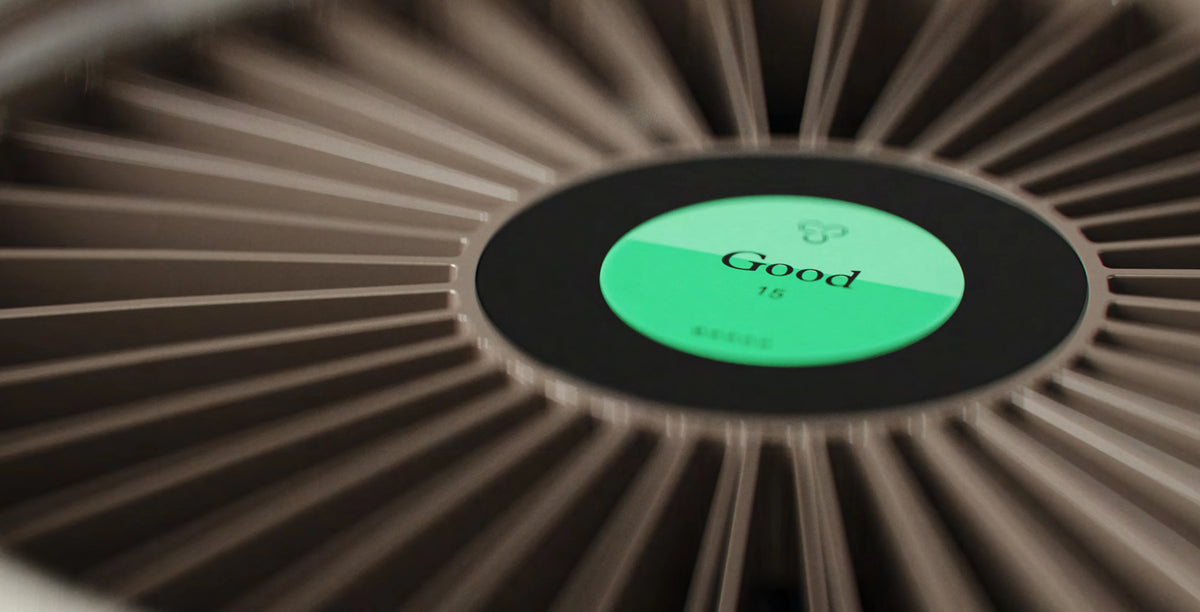
PECOAir+ purifiers reads the room continuously and reports particulate load and VOCs in plain language rather than a vague score.
Room vs. regional AQI: During fire season, that produces the comparison nobody's been able to make: the AQI on your phone and the reading in your living room, side by side.
This is your chance to experience it first.
Get notified for the presale of the new purifiers, built for the half of the problem you were never going to see.
Scientifically better air
™

© 2026 Molekule Group, Inc.