

Sleeping with a humidifier isn't bad for most people, but there are specific conditions where it can cause health issues, and those conditions are more common than most might care to admit.
Here's what can go wrong if you use a humidifier every night (though it’s unlikely that anything will go wrong), who should be cautious, and what the evidence shows when it's done correctly.
Is It Bad to Sleep with a Humidifier Every Night?
No, not if you keep indoor humidity between 40–50% and clean the unit regularly. Those are the two requirements that determine whether a humidifier is beneficial or harmful over time. Both are achievable. And when used properly, sleeping with a humidifier is actually good for most people!
When Sleeping with a Humidifier Can Cause Problems
Running It in a Room That's Already Too Humid
Humidity consistently above 55–60% actively encourages mold growth and dust mite reproduction, both of which significantly worsen allergy and asthma symptoms.
An uncalibrated humidifier running all night will make respiratory symptoms worse, not better. More moisture does not equate to better for you.
If you do this, you’re effectively adding moisture to an environment that doesn't need it, and the organisms that thrive in that moisture are the same ones that trigger the symptoms you're trying to address.
Some signs that humidity is too high:
-
condensation forming on windows in the morning
-
bedding that feels damp or cold to the touch
-
A musty smell that wasn't there before
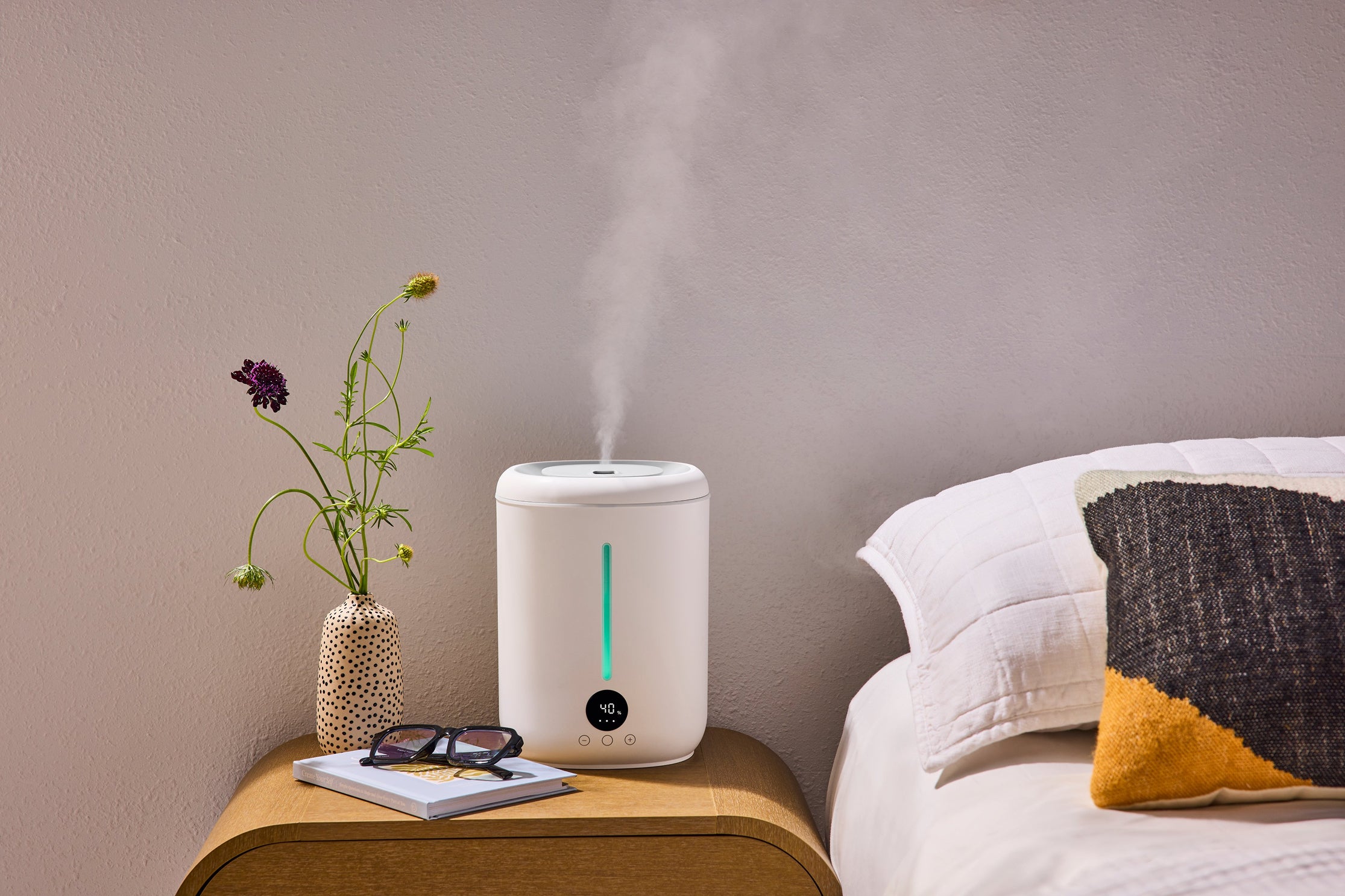
Easy fix: buy a digital hygrometer for $10-$15 at your local home improvement store. It’s the only tool that can give you an accurate on your room’s relative humidity. If you have a more advanced humidifier already, such as the Molekule ultrasonic humidifier, it will shut off automatically when it reaches the desired relative humidity.
Skipping the Tank Cleaning
Water left in a humidifier tank for more than 24–48 hours develops bacterial growth and biofilm. An unclean tank aerosolises that contamination directly into the air you breathe for eight hours while you sleep.
This is the most common way a humidifier becomes harmful instead of helpful, and it’s an easy fix.
If you notice worsened congestion or cough after you start using the humidifier, a musty smell from the device rather than the room generally, or recurring morning sinus irritation that wasn't there before, the tank is the most likely cause.
To clean the humidifier, simply drain and wipe the tank at least once per week; do a full clean with diluted white vinegar monthly. Allow the tank to air-dry completely between uses.
Using Tap Water in an Ultrasonic Humidifier
Ultrasonic humidifiers aerosolise water as a fine mist, including whatever minerals are dissolved in it. In hard-water areas, tap water contains calcium and magnesium that become airborne as fine white dust. These particles settle on surfaces near the unit and, more importantly, are inhaled overnight. For someone with asthma, this mineral mist adds airway irritation to an already-sensitive system.
To resolve the issue, just use distilled or demineralised water, which is what most product manuals will recommend in the first place.
Using Warm Mist Instead of a Cool Mist Humidifier in a Room with Children or Pets
Warm mist and steam vaporisers heat water to produce steam. The steam itself is fine, but warm mist humidifiers present a burn risk for children and pets who may touch or knock over the device during the night. The clinical recommendation from both the Mayo Clinic and Children's National Hospital is cool mist only for any room shared with children. For adults-only environments, either type is appropriate.
Is It Safe to Leave a Humidifier On All Night?
Yes, it’s safe to leave a humidifier on all night, as long as relative humidity stays below 55%, the tank is clean, and you're using distilled water.
Running a humidifier 24 hours in a closed room without adequate ventilation is where over-humidification becomes a consistent risk. Overnight is fine; all-day-and-night in a sealed space requires more careful monitoring.
The Benefits of Sleeping with a Humidifier When You Use It Correctly
Clearer Nasal Passages and Easier Breathing
Moist nasal passages maintain cilia function, the airway's primary debris-clearing mechanism, and reduce the overnight inflammation that comes from breathing dry air. This is the primary functional benefit of nightly humidifier use, and it's cumulative: consistent use produces better results than occasional use.
Better Skin Hydration Through the Night
The overnight period is when skin repair is most active. Humidity above 40% reduces transepidermal water loss (TEWL) during this window, directly benefiting dry skin, eczema, and anyone who wakes up with parched-feeling skin despite adequate hydration.
Fewer Sick Days During Dry-Air Season
NIH research associates indoor humidity above 40% with reduced airborne influenza particle viability. Dry winter air extends the survival of viral particles; adequate indoor humidity reduces that risk.
Reduced Snoring and More Restful Sleep
Dry throat tissue vibrates more readily, contributing to snoring. Consistent overnight humidity can reduce this progressively. Note that this does not apply to snoring caused by sleep apnea, obesity, or other health effects.
Where to Place a Humidifier in Your Bedroom
Where you place your humidifier makes all the difference in terms of effectiveness. Follow this short cheat sheet.
Distance: At least 3 feet from the bed. Close enough to raise local humidity without directing concentrated mist at your face or pillow.
Height: On a nightstand or dresser, elevated from the floor. Humidity disperses more evenly from a raised position, and the mist is less likely to saturate nearby carpet or flooring.
Direction: Not pointed at walls, where concentrated moisture can encourage mold growth in paint or drywall over time; not pointed at electronics, which moisture can damage.
Frequently Asked Questions
Is it bad to sleep with a humidifier every night?
No, it’s not bad to sleep with a humidifier if you keep humidity at 40–50%, use distilled water, and clean the tank every 1–2 days.
Can a humidifier make you sick?
An unclean one can. Bacteria, mold spores, and mineral deposits from a dirty tank are aerosolised into the air you breathe overnight. A clean humidifier presents no health risk for most people.
What are the signs my humidifier is causing problems?
Worsening congestion after you start using it (not attributable to illness), a musty smell coming from the unit, or condensation forming on windows in the morning are the primary warning signs. Clean the tank and verify your humidity level.
Is a humidifier or air purifier better for sleep?
They serve different functions and work well together. A humidifier adds moisture; an air purifier destroys airborne particles. Running both simultaneously addresses humidity and biological air quality as separate problems with separate tools.